Nothing is Sacred
a collaborative interview with Claire Carroll & Andrew Hykel Mears
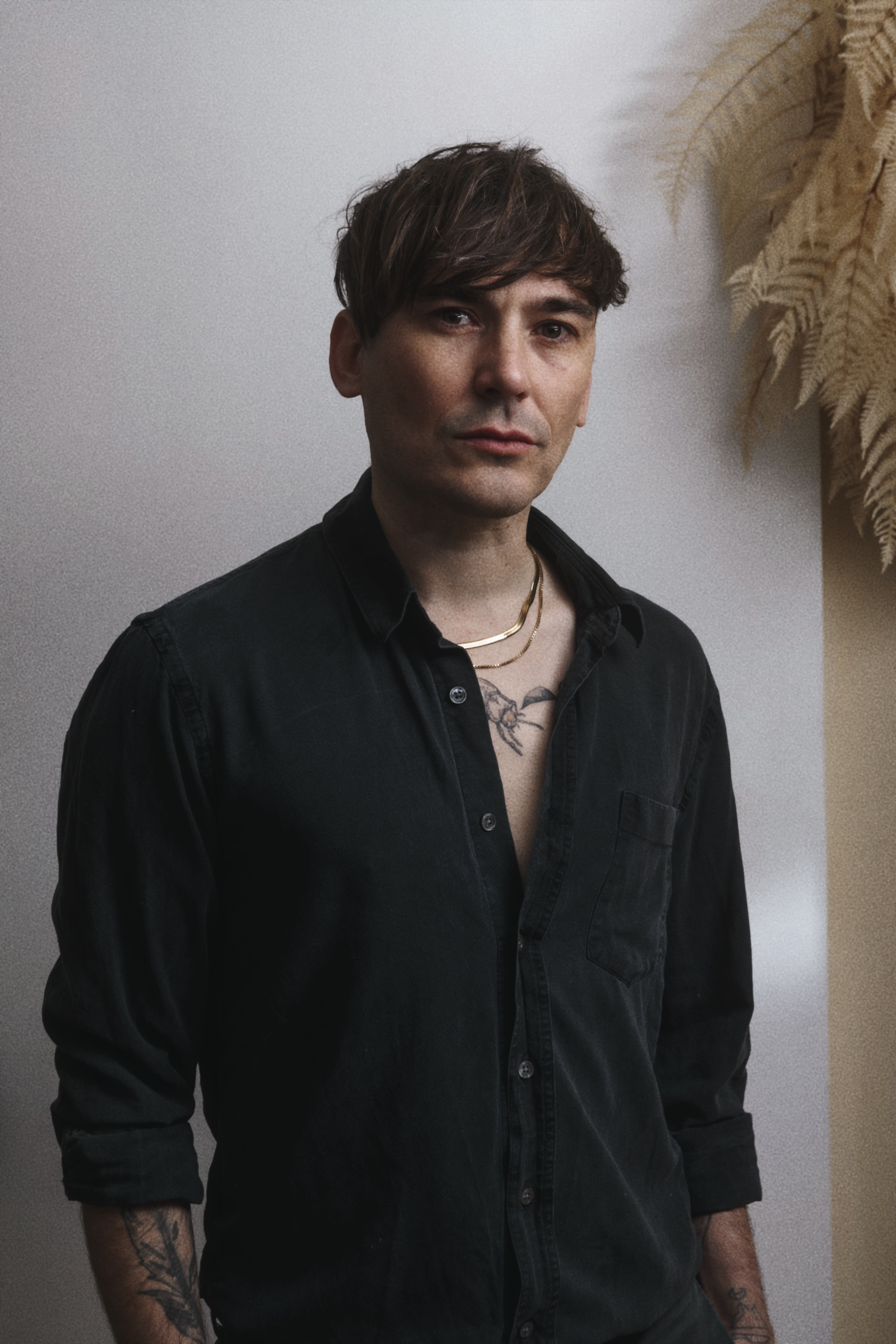
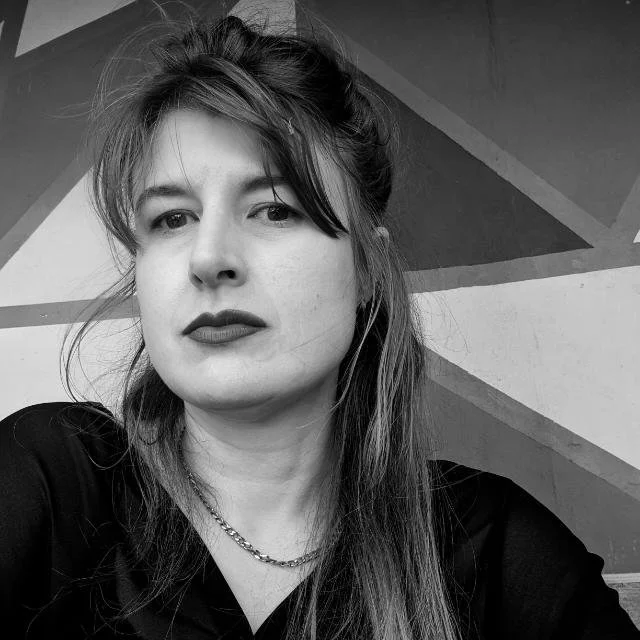
Andrew Hykel Mears and Claire Carroll met at Bath Spa University at the tail end of 2019 in class for a module called Writing & The Environment. In 2022, Andrew suggested a joint writing project, in which nothing was sacred. The result of that project is TREATMENT, the forthcoming book length text released in September 2026 with Dialect Press.
Below is a Q & A session Andrew and Claire held with each other about the production of the text … in which neither of them are clear on who is questioning whom.
A kind of fallout miracle. I fell in love immediately with this voice, the low key despair, and the hope lying just out of sight. An incredible collaboration.
~ Ben Pester, The Expansion Project (Granta)
***
CC: Andrew. I remember that you started this. But why did you start this?
AHM: I don’t think I like your tone, Claire, but I must have at the time. The main thing was I wanted to work with you specifically, pal. We’ve always supported one another’s work and making something together just felt inevitable, I guess. We both tend to negotiate with uncertainty and what it means to make art from within the attention economy and the surreal dread of the now - is that fair to say? But our eye for what’s happening on the page is fairly different from one another, I think, I had an instinct that it would work. You always made me think more clearly about my own work, or at least want to rise to the things you said about it. Starting with messing around in bands, I’ve always been drawn to collaboration. I think when you do something like that for so long you get a keen sense of what your collaborator might bring to the table that you don’t or can’t. Plus, whereas I’m someone who starts a million things at once, you actually finish things. I think the real question is why did you go along with it?
[time passes. Hours, or maybe longer units of time? Days?]
CC: Sorry about my delayed reply. I’ve been terribly busy. I’ll send an answer in full later on, but, for now, please accept my most sincere and decent apologies.
AHM: How is it back to the episode of Frasier where his new ethical agent arranges for Seattle Zoo to name a crane in his honor? Months? [Tacitly accepts apology]
CC: [a little later on, when everything is quiet] Sorry about my tone. I appreciate that I have a very loud and abrasive voice which must ring very unpleasantly in your ears as you read this. Yes pal, I recall wanting to work with you specifically too, pal. I agree that we both were (and still are? Possibly. I’ve no idea what you’re up to nowadays…) making work that was about the surreal dread of now. We didn’t call it that though. That’s a name you’ve come up with after the fact. Classic. I’d like to remember why I went along with it so that I could answer your final question. My attention span isn’t what it was. I feel like it was a displacement activity for some other, huge and untenably onerous project we were having to do? But it’s like, I can’t remember what that was now. I feel like it involved landscaping something, somehow? Or ship-building. But we weren’t actually building a ship. That much is true. We definitely were not doing that. I remember a lot of finely drawn plans. I remember disgruntled stakeholders. Anyway, whatever it was, we pulled it off really well and then we did this project alongside it for a bit and then continued on until it was finished. I like finishing things, yes.
AHM: Never forget the stakeholders. I’ve let them know - via the internal newsletter - that the dog, a clumsy, glad animal that lives with me, trod on (and cracked) my computer screen. That I’m now plugged into my grandfather’s 90’s Sony Bravia television to write. The TV screen is incredibly low resolution. So much so, that the resolution of all other things orbiting it (a to-do list, a pile of books, a wooden letterpress type case filled with bright white vegetables made from air drying clay, several dirty mugs, my own resolve) have lowered in resolution also. My memory has always been patchier than yours, and maybe less generous. So, I can’t say if we pulled it off really well, but I have no complaints on file–
CC: Oh no, I can’t say that we pulled this off really well. We pulled off the other project, the one with the stakeholders, really well. The success of this TREATMENT remains to be seen. What do you remember about when we started this project?
AHM: I do remember that we had no real plan for how the collaboration would unfold. We agreed that nothing was sacred, and that anything the other wrote could be pushed around or erased altogether. I was definitely interested in getting somewhere plural - and it is hard to say who wrote what. There was no plan, but we definitely fell into a pattern of response - how would you characterise that?
CC: There were certainly patterns that emerged, and it became a dialectic quite quickly. I reckon we were trying to see what it was possible to get away with. Like, you said to me nothing is sacred and then sent me some lines of poetry you’d written thus far with an invitation to do whatever I wanted. I found that phrase - nothing is sacred - to be a hilarious thing to say. What if I’d just deleted the lines you’d written? What if I just kept on deleting and deleting every time you sent something? When someone says something like that, you immediately (or I do at least) start wondering whether they actually mean it. Is nothing really sacred? Surely some things are!
AHM: I think I thought that I meant it. Still, I’m easily discouraged and if you’d entirely deleted it doubt I would have ever recovered. I am a precious flower. Sometimes you have to go too far in the proposing of the thing to go far enough to find the thing that’s the thing. I like the idea of the compromise still living on an extreme. But if, for instance, becoming irritatingly vegan, means others simply do it for January that’s not nothing. Whatever the case, enough was written-over and deleted that, for the most part, I sincerely don’t know who wrote what. It was interesting to arrive at a mutual voice. I had a period of creative emptiness afterward, like a break-up or going on a new anti-depressant.
CC: [screams] Would you consider yourself a vegan influencer?
AHM: Absolutely, yes. I’m the most virtuous man alive. *Taps nails on extreme close up of firm tofu.
CC: I suppose we’re saying the same thing, then, that by searching for - or maybe leaving an option on the table for - extremity within the end result, you reach something that feels daring in some way.
I worry that collaborative work - especially this type of surrealist/absurdist practice - can push things too far sometimes, and the playfulness of the process seems like an in-joke to those outside of it. How does that align with ecological writing, which many readers will associate with a sense of quiet grief, or threat?
AHM: Yep, that's the question, isn't it. I know we both think about it a lot more soberly than this conversation lets on.
I don't think ecological writing 'associated with quiet grief or threat' and playful, absurdist, in-jokey collaboration are actually in tension, though they feel like they should be. The grief is real. But the demand that grief be legible as grief, it announces itself, performs its seriousness, and behaves the way a reader expects mourning to behave, that's a demand that's doing something else entirely. To me, it's asking the work to be extractable. A clean feeling, harvested in a single pass. And I don't think that's honest to what ecological loss actually feels like from inside it. In my experience the feeling is maybe closer to what we've been doing than to some kind of elegy. It's disordered. It loops. It laughs at the wrong moment and then feels queasy about laughing. It says nothing is sacred and means it and doesn't mean it in the same breath.
I do think when the playfulness reads as an in-joke to someone outside it, it's for sure a real cost. Still, I'd rather pay that cost than write a poem that performs grief cleanly enough for a stranger to recognise it as Grief-with-a-capital-G on first contact. That legibility is its own kind of violence, weirdly. It's the same demand the attention economy makes of everything - to resolve quickly, to confirm what I already feel, and to not make me linger.
What I want instead (what I hope TREATMENT does), is closer to what I'd call ecopacity than obscurity—
CC: [mumbling, kind of singing] eco-peepo–co-capacito-ocapicity –
AHM: [ignores interjection/internalises scorn]–There's a difference between withholding meaning that closer attention might recover, and preserving something that resolution would actually destroy. I don’t think the in-joke quality is decoration on top of the grief, it's a way grief can be held without being flattened to a mood a reader just consumes and sets aside. I don't reckon ecological writing owes you clarity on first contact. What it owes is seriousness whatever clown-costume that seriousness whacks on. If someone stays with it and lets the joke curdle into something else on a second read - perhaps that's where the actual grief is. Not in the parts that announce themselves as sad, but in the fact that us two needed absurdity that badly in order to get anywhere near it. Does that make sense? Is it just a nice excuse for not being able to write something without immediately undermining it?
[voiceover] An interview is never finished, it’s just abandoned.
Join us for the online launch of TREATMENT, Wednesday 23rd September, 6.30pm. The event is free but please book here to receive the Zoom link. Purchase your copy of TREATMENT below.
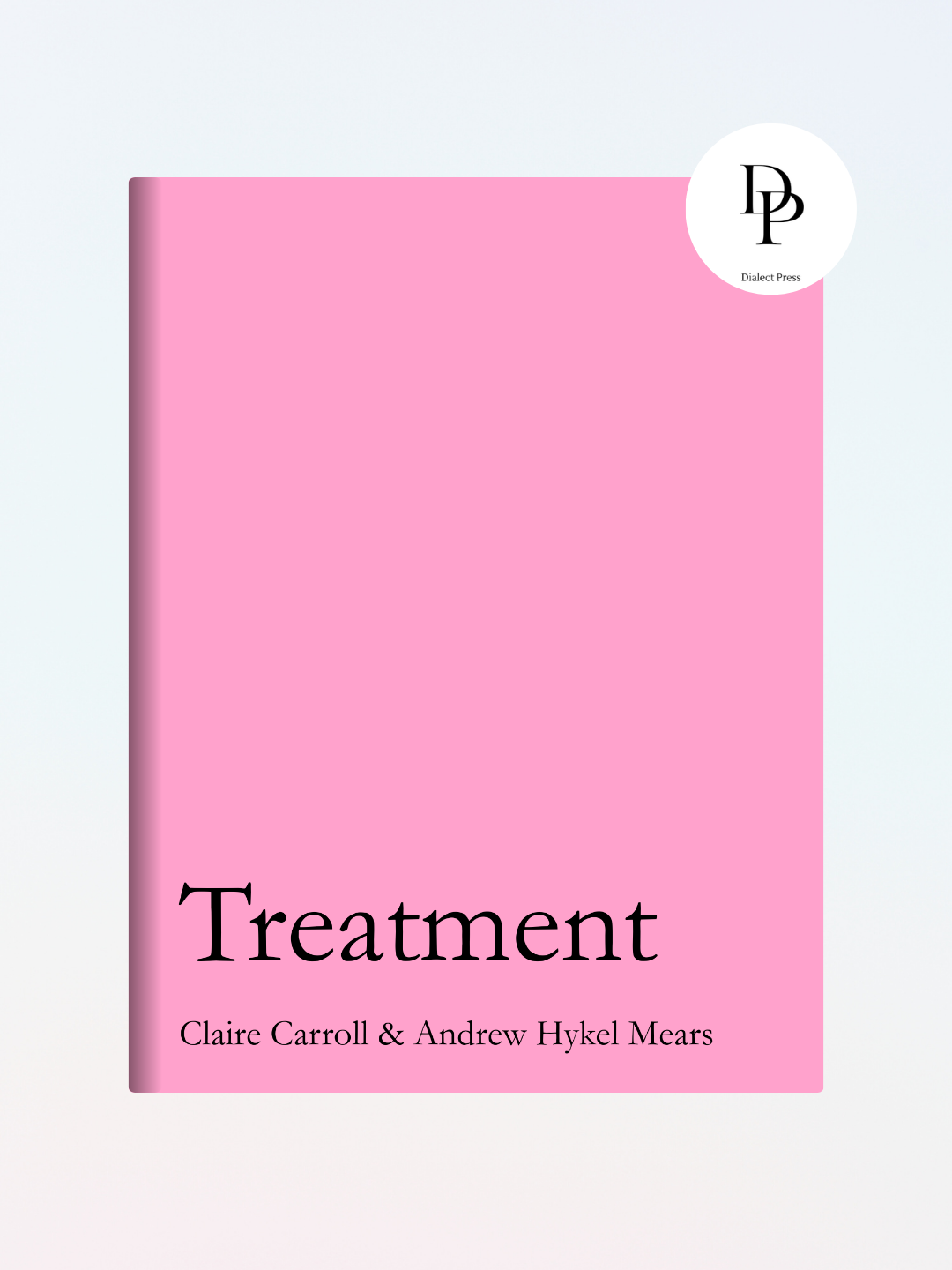
Now open for pre-orders, the new pamphlet from Claire Carroll and Andrew Hykel Mears is Treatment, a wry take on late capitalism full of wit, humour and pathos. We can't wait for you to read it!
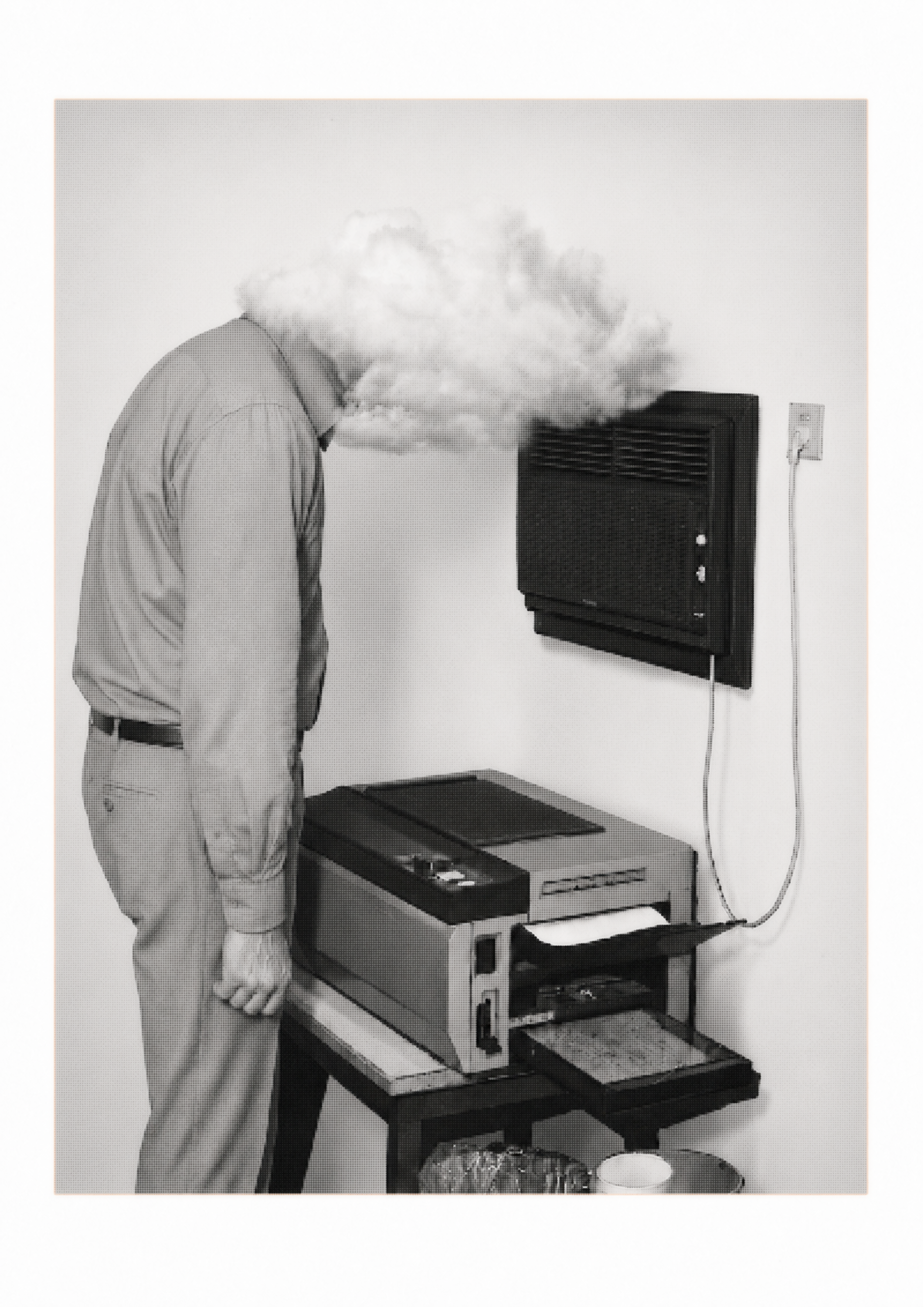
Beginning with an introduction to a meeting, the opening verses introduce a proposal for an advertisement film; a Treatment. From here, the narrative digresses into vignettes - a couple attending a house-viewing, a swimmer in a marine lake, a comedian on stage, artists making a performance piece - returning periodically to the ‘room’. The text is disrupted by imagery, footnotes and other distractions, but returns again and again to the assertion that there is ‘no sense of an end’.
Preorder Treatment now and help us to build momentum for this brilliant new publication!
Orders will be sent out on the day of publication 23rd September 2026.
About the authors…
Claire Carroll is a writer and PhD researcher whose work explores how experimental writing can reimagine how we relate to nature and the non-human world. Her debut short story collection, The Unreliable Nature Writer was released in 2024 by Scratch Books.
Andrew Hykel Mears is a writer and PhD researcher proposing ‘Ambient Eco-Poetics’ as a way to write with the more-than-human. Open Ribs are a Church Full of Sky was released in 2024 by Bread & Roses Press. Rivering was released in 2026 by Scarlett Tiger Press. He’s founder and EiC of the interdisciplinary small press Ambient Receiver.