Remembering the Future by Philip Rush
Associated General Examination Board
GCE Society
Paper One Two Hours
Answer three questions, at least one from each part of the paper.
All questions carry equal marks.
Part One: The Past
By reviewing the social history of the UK in the last three generations, can you establish when our society surrendered its space, its safety, its lifestyle and its future to the motor car, and why?
What, in your opinion was the link between the names of public houses and the nature of the community facilities public houses provided? Use specific examples where you can. You may wish to consider public house and inn signs.
What role has mass media played in manipulating society’s aspirations and dreams, and how has art in any of its forms responded to such manipulation?
Would you distinguish ‘happiness’ from ‘contentment’? How has European society sought in the last fifty years to make the vast majority of its members ‘happy’ and ‘content’?
Explain how you react to the following statement: ‘Let us stop thinking of human beings as autonomous, omnipotent and limitless, and begin to think of ourselves differently, in a humbler but more fruitful way’.
‘The ethical decadence of real power is disguised thanks to marketing and false information.’ What have individuals been able to do to change the stance of governments in the face of climate change?
Write an essay explaining either that we can learn nothing from the past, or that ‘we can never move forward without remembering the past’.
Part Two: The Future
How inclusive do you find the the slogan, ‘Clean air, clean water, clean soil, clean energy’?
‘Development must not aim at the amassing of wealth by a few.’ What, do you think, will the word ‘profit’ come to mean in coming years?
‘Everyone together can hold up the sky.’ What, and in what ways, will it mean for every member of a community to be ‘useful’?
How far do you agree with the statements that ‘ideally, unnecessary migration ought to be avoided’ and that ‘this entails creating in countries of origin the conditions needed for a dignified life and integral development’?
‘We cannot expect a better world, a bright and peaceful future, if we are not willing to share what we have received.’ In what ways, then, is diet a political issue? Can we imagine a manifesto for a better diet?
Explain how you react to the following statement: ‘Indigenous peoples are not opposed to progress, yet theirs is a
different notion of progress, often more humanistic than the modern culture of developed peoples. Theirs is not a culture meant to benefit the powerful.’
How far do you agree that in discussions about climate change ‘the actions of groups negatively portrayed as
“radicalised”’ are simply ‘filling a space left empty by society as a whole’ and that ‘every family ought to realise that the future of their children is at stake’?
Nowhere Man
There’s a 90B bus down at the end
of my garden, behind the trellis,
by the compost bin, beside the rusty
incinerator and the disused rabbit
hutches – weird, don’t you think? –
and parked where the garden shed
used to be. I get on. It’s full
of conkers. Hoes. Rakes.
Cobwebs thick as hawsers. Obviously,
not that thick. Sorry. Got carried
away. A lawnmower and, over there,
car-chains, oiled, wrapped in sackcloth.
It starts up. The bell rings in that way
bells always ring on ghost buses
full of conkers. By the time
we get to Fulwell it’s 1965
and the sky is full of Comets,
Britannias, long thin clouds
like something trimmed off
at a dressmaker’s. The conductor
will not accept decimal currency
and shouts so slowly I start to think
I’m French. I’m not.
I’m from the future.


we can never move forward without remembering the past
– Pope Francis
In his ‘Letter on the Renewal of the Study of Church History’
Pope Francis reminds his readers that ‘we can never move forward without remembering the past’.
My grandma, who was born on the Surrey / Sussex border in 1895, lived in Feltham from about 1924 to 1974. In around 1975, when I was a student, I recorded her talking about her life. About twenty minutes. I had that recording on a cassette. I did not listen to it for fifty years. Not once. Maybe out of superstition; my grandma died within a year. Maybe out of fear: what if the recording had not worked? Now, I have had the recording transferred to CD. When I listen to it, I wish I had recorded more. That is, I think, only natural. I should instead be grateful that I have what I have. There are extracts below.
The thing which has survived is, of course, my grandma's voice, that wonderful Middlesex accent with, I have to say, just the occasional Sussex vowel. This is the voice of a working-class woman born in the nineteenth century, who survived two world wars and who was proud of what she had achieved, despite everything.
The photograph shows her in the early years of the Great War. She looks wonderful, of course, but I really like the subtle ostentatiousness of her engagement ring, which is what the photograph is really about. Her story explains why that engagement did not provide the wedding ring she had dreamed of.
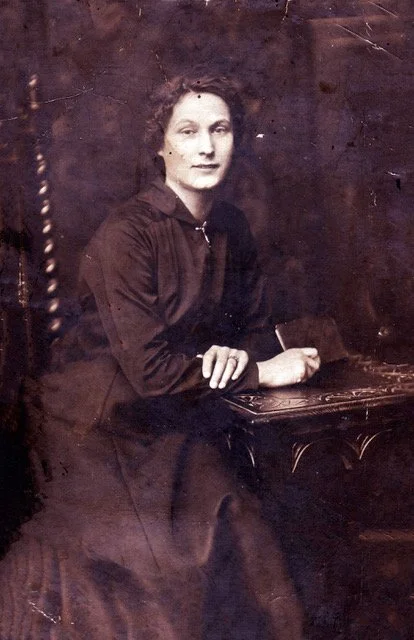
Grandma
our grandparents held poems in their bones but no-one ever asked them to write them down
– Roger Robinson
Roger Robinson, the poet, has made the aphorism something of an art form straddling wisdom and practical advice for writers. This is one of his aphorisms.
I don’t remember living in the countryside. No, I don’t remember living there, only when I went to stay there with my grandmother. I went to stay with her for a year. When my mother was in hospital. Then I came back, went to Laleham School. I went to Chiddingfold School. Then I came back and mother got well. I came back and went to Laleham School.
For three or four years. Then I went on to Ashford. Then from there I went to Staines. I lived at Staines till nineteen twenty-four. I lived at Staines.
I remember going to school. At Chiddingfold school. I was only five and I had to walk two-and-a-half miles to school, every morning, and two-and-a-half miles back. At five years old.
We used to meet the stags and the hounds and the fox, the otters. They all used to come into my grandma’s garden. Yes. We’d stand out there and watch them. And while I was down my grandma’s, we used to go out to do the shopping. I used to go with grandma, her donkey and shay. And one Saturday we went out shopping and grandma always went and had a glass of stout, give me a glass of lemonade or something. Coming home, coming along the road, the donkey wouldn’t go, he wouldn’t go, don’t matter how hard, I used to drive him, he was so stubborn, and I give him a smack on his backside, I said, and he’s, went across the road and threw us in the ditch. I saw grandma, there she was, oh I said, we were trying to get out, I seen a man come along and he said, “What’s the matter, Ma?”
She said, “The donkey’s throw us in the ditch. He wouldn’t go and Emily,” she said, “give him a smack, he’s come right across the road and into the ditch,” she went.
I remember my uncle. Uncle Harry. My mother’s brother. He used to play cricket at Chiddingfold, on Chiddingfold green, and one day they got him to sing a song, on the green. His photo was in the Daily Mirror1 and he was singing for all he was worth. He used to play cricket. Uncle Harry, he could sing, too. He’s singing a song for all he’s worth. I was out to work then.
I went out to work when I was thirteen. In the laundry. Four shillings a week. I was a nursemaid for a month. Half crown a week. But I do that job in, I stopped there no longer. She wanted to keep my half crown a week and buy me a uniform.
And I said to mum, I’m not stopping there. I came home. My dad was ill. Hard times then. Mother had no money coming in and she had all us to keep. My brother, my eldest brother was in the Navy, he went off, he went to the First World War, and he was invalided out. For nerves. We used to have the soldiers, they used to be billeted on us. Used to come there for one night, to sleep and we used to give up our beds, to spoil them so they should have a night’s sleep before they went abroad. And I remember Mr Dent. The kid man, the kid man, the kid-glove man’s son, Mr Dent2, I think it’s Dent, he was there one night. He offered me his watch, before he went abroad and I told him he was to keep it, he would want it, I said. And I had a nice letter from him. I never heard no more. I don’t know whether he got killed or not. And I had another one, that come there, um we were saying what we nicknamed them all, and then went, so he said, So what name you going to nickname me when I’m gone? And I said Old Bald Top, I said. And I went to choir practice one night because I belonged to the Wesleyan choir, and mother come down to meet us, my sister Eva and I, and she said there’s a letter down for you, Em, she said, I think it’s from that Bald Top, so I said, he hasn’t written to me, so she said yes he has.
I said and it was and he sent me some maple leaves, a picture of maple leaves in it.
Yes. The young man I went with. He got called up. He came out, he’d been gone two years and he came home in the Christmas, bit before Christmas, and Mother made him up a nice parcel for him. He had no mother and father, he was with his uncle and brother. And their two brothers. And he went back and in the January after he’d gone back, he hadn’t been gone back long, I had a letter to say he was missing. And I never heard till six weeks afterwards that he was blown to bits. He was a bomb thrower. Never heard till six weeks after that he was missing.
At the end of the war we had a young chap living with us, Mother had a young chap living, what was his name now? And I said to him, when did it end? What month? September, was it? Oh yes. November. I said to him, I said that, I think his name was Bob, I said, The war will end in November. And he said, How do you know? I said, I’ve got presentiments. That the war will end in November. So he said, I bet you a box of handkerchiefs and you bet me a tie. I’ll bet you a box of handkerchiefs that it won’t be over, he said. And if it’s over I’ll give you the box of hankies. If not, if it’s not over, you’ll give me a tie. Well, I won it. Yes. I won it.
We used to have to go out and queue up for food. Couldn’t get butter. And I remember once my mother saved all the milk, all the top of the milk off the butter, off the milk, to make a bit of butter. Her and me sat up one night making this butter out of this milk. And we made nearly a quarter pound we made, and when we come down in the morning, my sister Rose had put all the lot for her sandwiches. So we worked for nothing. We made this butter and we didn’t have any of it. But my mother was wild.
I used to go to the Wesleyan Chapel. We used to go to choir practice. We used to clean that chapel out every month, clean it out, go and clean, do it every day, everybody came, and do it, and we used to hold concerts and that for the soldiers, Saturday nights, give them free tea and buns and that. We used to. We used to make all our own enjoyment.
Because we had no pictures or nothing them days. But there was nothing going on like it is today. We used to have to do as we was told and be in at a certain time. Nine o’clock I used to have to be in. Otherwise I was … Yes I did. I was twenty-eight when I got married. I met my husband, I said, I went to tea at the place one day, and I met him there, and he said, I’m going to take you home, and I said, You’re not. He said, You are, I am. He asked me to go to the pictures with him, that’s on that Monday. Go and see “Chu-Chin-Chow’’3. So we went. But we couldn’t get in. That was the first time I met him.
Notes
1 Probably the ‘Surrey Mirror’, in fact. I have found in that paper reports of Chiddingfold cricket matches in which Harold Mann appeared
to have excelled with both bat and ball.
2 https://www.dentsgloves.com/ I contacted Dents Gloves with this story; they said ‘it moved …’ and their CEO Deborah Moore rang me to talk about the company, the family and their connection with Sudeley Castle. With this information I could confidently identify the man who offered his watch as Captain Jack Dent-Brocklehurst of the Coldstream Guards. He survived the war.
3 I have found that this was a film (silent, of course) released and first shown in 1923/ 24.
Family names on Randwick war memorial
Anderson Asher Bennett Brain Edmonds Mills
Harmer Hill Pearce Pollard Smith
Vick Watkins White
William Mills and Ernest Mills
are both recorded as having been killed
on July 23rd 1916.
Six Poems for Jane Jacobs
A primary school, a pub,
a shop like Auntie Jelly’s,
a park which provides
a safe place to play,
green spaces, a clean river.
Prospects.
•
A church, a village hall.
A bus stop or two. A bobby.
Milk, post and papers.
•
In the town,
secondary schools,
restaurants, a cinema,
transport hubs,
shops, a library,
a surgery or two,
an arts venue,
places of worship,
a leisure centre.
•
In the city, a hospital,
a cathedral, shops, hotels,
a railway station,
a bus station,
clean air, a sports stadium,
council offices,
employment.
A proper park.
Community places of worship.
Jane Jacobs (1916-2006) was an urban writer and activist who championed new, community-based approaches to planning for over 40 years. Her 1961 treatise, The Death and Life of Great American Cities, became one of the most influential American texts about the inner workings and failings of cities, inspiring generations of urban planners and activists. Her efforts to stop downtown expressways and protect local neighbourhoods invigorated community-based urban activism and helped end Parks Commissioner Robert Moses's reign of power in New York City. Jacobs had no professional training in the field of city planning, nor did she hold the title of planner. Instead, she relied on her observations and common sense to show why certain places work, and what can be done to improve those that do not.
Some Gloucestershire Place Names
Arlingham Elmore Epney Frampton-on-Severn Fretherne
Ham Hamfallow Hinton Longney Slimbridge Stone
Wotton-under-Edge Nailsworth Stonehouse
Dursley Stroud
Gloucester
Water Levels
Golden sodden leaves
at Seven Springs.
The breath
of a small and rural angel,
careful steps down
into the Thames basin.
The third of each month
I check the levels.
Where I grew up
a reservoir meant
manmade bulwarks,
a raised lake which gurgled
with wild-fowl, old bombs
and mythical eels.
There were prohibitions
and tall fences.
Reservoirs and economics.
Saving
for a rainy day
or bonfire night.
Water per se’s been sacred
for ever.
Millions of gallons of Thames
held captive.
And in the dark half of the year
a dull wind
which could not be pacified
from Seven Springs.
Here above this embankment
(Iron Age,
medieval, motte and bailey,
Brooklands),
long-haul flights in and out
of Heathrow
clutter the soundwaves,
din the waters.
In the driest weather
something stirs
in the deepest mud.
Air-raid sirens sound.
They have found a bomb.
We open windows
until all our fireworks
go off at once.
Our reservoirs were landmark,
watermark,
and navigation landing lights,
beacons.
Beneath a dark sky,
they were holes amongst
the galaxies
into imagined earth.
Philip pours a full glass.
Watches it settle.
West Middlesex Water Company
pray for us.
Some Gloucestershire Rivers
Avon
Little Avon
Nailsworth Stream Painswick Stream Slad Brook Frome
Severn
Churn Coln Duntisbourne Evenlode Leach Windrush
Thames
I’ll push into the roots that died when place was cleared of place
– Jorie Graham
Towards the end of her poem ‘When overfull of pain I’, Jorie Graham includes the lines:
‘I’ll push into the roots that died when place was cleared of place’.
I am a very keen re-reader. I have always enjoyed re-reading books. Partly this is because a quality of a good book is that it reveals on a second or third reading new depths and subtler meanings; partly it is because a second reading of a book removes significantly the drive towards an ending which propels so many plots, especially perhaps those in children’s books, so that the reader can enjoy each development for its own sake and at its own pace, and finally, because re-reading is comforting and friendly.
When I was at school, I read Arthur Ransome’s stories repeatedly. More recently I have enjoyed reading many of Rachel Cusk’s novels and I have re-read each one. John Berger returns again and again for a thoughtful chat or two; I try to read Virginia Woolf’s To the Lighthouse at least once each year. I think I may have read The Lord of the Rings too many times.
We used to go to Hanworth library where I would borrow the same books alongside new ones. Maybe this is another reason: I was not taking a risk re-reading a book I knew I’d liked before. If I were a t-shirt slogan person I think my slogan might be something along the lines of a ‘if a book is worth reading, it’s worth reading twice’. Though that slogan is not quite as pithy as I thought it might be when I began to type it.
One of the books I used to borrow on more than one occasion was about building a house. I must have been about eight years old. The builder accosts a young boy who walks by a building site each day on his way to school. I did not walk past a building site on my way to school. We walked through the estate, towards Goodlake’s the grocer and The Brown Bear pub, then across the road at the zebra, where a policeman would be on point duty, past the Oxford Arms and the greengrocery and then up beside the big road past The Jolly Airman. Sometimes we’d cross over and walk beside the line of shops. A newsagent’s, a small toy shop, a dry cleaner and so on. There was a telephone box, button A and button B, but there was no building site.
The builder tells the boy that they have to start the house they’re building by digging a neat, rectangular hole, much deeper than he might think. The builder expects him to be surprised by this, though I never was, in fact, not even the first time. The whole first chapter is about the digging of this hole and about the function and nature of foundations.
It is significant that a house for the future should begin with the digging of a hole. I see the builder’s paradox more clearly now. In order to prepare for the future as wisely as possible, like a sensible pig in wolf country, he must adopt the role of archaeologist and dig into the past. We love reading about the discovery at a building site, or where they’re running a huge road through fine land, of Roman pottery or a bag of Anglo-Saxon coins or a piece of valuable jewellery from medieval times. We may allow ourselves a delight in the mischief the past has caused today’s thoughtless expansion. Deep down, everybody knows, even the developer and the road-builder, who hate delays and interference, that without a respect for the past, thoughtless progress will sully the future. On the other hand, without a rummaging through of the past, without the hole, the new house will flounder. The past repeatedly reminds us of the difficulties of creating a future.
In the early 1970s, Hanworth Library was relocated to the north and the old building demolished. The infants school was closed and pulled down, the greengrocery too, along with The Brown Bear and the Oxford Arms. The road we crossed with a policeman was replaced by an elevated dual carriageway which linked the Chertsey Road to the M3. People could drive much more quickly now from Richmond to Winchester, but it was impossible to walk the route we took to school. Hanworth village was cut in two and its heart destroyed. Things there have not been the same again. I can’t remember the name of the book about digging holes and building houses. It had a yellow cover I am sure and a picture of the builder in blue. I think he was carrying some tools and that a wheelbarrow may have rested beside him.
I typed into Google, “children's book from the 1960s explaining the principles of building a house”, which shows a certain naïvety in my understanding of the way search engines work. There were a few books in the first few entries, books with titles like 50 Books that Every Architect Should Read. The tenth website recommended to me was the Wikipedia entry for Jane Jacobs.