Vasiliki Albedo & Lucy Holme in conversation
Some creative partnerships begin with a plan; others begin with a spark. Sardines, the new collaborative pamphlet from poets Vasiliki Albedo and Lucy Holme, began with something stranger and more serendipitous: a misremembered remembered Frank O’Hara poem. From that ‘mistake’ - part omen, part invitation - a year-long conversation unfolded.
What started as a loose ‘call and response’ soon deepened into a hybrid form: poems passed back and forth, prose interludes stitched between them, and a growing sense that the work was shaping its own currents. Themes surfaced and resurfaced - girlhood, grief, appetite, the sea as both sanctuary and warning - not by design but by the natural drift of two poetic minds in dialogue. The pamphlet’s title, Sardines, holds this tension beautifully: the ordinary made luminous, the playful shading into the political, the small thing that opens into a world.
In this interview, Vasiliki and Lucy reflect on how the project began, how their voices braided together, and how collaboration altered the poems they thought they were writing. They speak with candour about coincidence, influence, ecological unease, and the joy of finding kinship on the page. What emerges is a portrait of creative trust - two poets listening closely, answering intuitively, and discovering themselves, again and again, pulled along by the current.
How did the project originate?
Vas: The idea for the pamphlet was proposed to us initially by the brilliant Juliette Morton, who is a mutual friend. We had free reign on subject and decided we were both quite interested in travel and tourism so we let that thought marinate for a little while before we started writing. As we started to create, we were both amazed by certain coincidences in our texts. The title of the pamphlet came out of our opening exchange, when thinking about mass tourism and a protester in Spain holding a placard with the word ‘Sardines’ brought to mind the O’Hara poem ‘Why I Am Not a Painter’, the title of which I misremembered. We decided to leave that error in as it cascaded into the resulting poems and thoughts. And the amazing coincidence was that Lucy had simultaneously been drafting a poem to send to me (this was at the very beginning of our collaboration) in which she also used the word ‘sardines’.
Lucy: What began as a ‘call and response’ project, circling the very broad themes of place, language, travel and tourism—things that we both have written about and find interesting turned into a hybrid epistolary poetic exercise. We began to write prose ‘interludes’ to one another, firstly by email and then by replying to each other on the document and decided to include them. The conversational nature of the chapbook grew from there.
Why have you called the book Sardines?
Vas: We chose Sardines as a title for the pamphlet because it captures the pamphlet’s central tension: the sea as both paradise and pressure chamber, where memory, desire, girlhood, the slipperiness of representation, and grief are held in close, glittering proximity. The title nods to Frank O’Hara’s associative leap—how a single image can become an organising principle—and to the repeated presence of fish, tourism, and appetite throughout our poems. Sardines suggests what it means to be preserved, consumed, crowded, and watched, while still insisting on lyric freedom: one small, ordinary thing opening into a whole page of meaning.
Lucy: Sardines was very much the ‘working title’ for a while and although we tried other ideas including, for a while, Paradise or Wonderland, Sardines had the kind of irreverent tone we liked and contained multitudes of meaning. There is a central idea that we explore in the pamphlet which is what remains? What is left over when everything else has gone or has been taken? This idea pertains to personal loss as well as more global concerns such as climate change and ecological collapse. Sardines, as a globally threatened species due to overfishing, seems like a fitting, if slightly unexpected, emblem.
Had either of you collaborated on poetry or artistic projects before and if so, how did the process of writing Sardines differ?
Vas: I have previously collaborated on two pamphlets with poets Mary Mulholland and Simon Maddrell. They were themed around our mothers and then fathers, so there was a ‘stricter’ theme, whereas in this collaboration we started out with an idea of a theme but it shifted and sprawled as we went on quite organically. In the previous collaboration we had edited each other’s poems, and there was an element of that in this collaboration too, but the focus was more on mutually bouncing off thoughts and resonances in our texts. Many poems were inspired by the poems Lucy sent me, for example I wrote ‘Learning to Surf’ after reading Lucy’s ‘Why I never learned to surf’. Collaborations are wonderfully inspiring and I will definitely miss the spark and joy our interactions brought into my poetic life.
Lucy: I had never collaborated on a poetry project before but have been involved in artistic collaborations during my MA in Creative Writing at University College Cork with Crawford College of Art and Design and more recently, with The Glucksman Art Gallery and the Irish performance artist Amanda Coogan. Before we embarked on this project I had admired Vasiliki’s poetry for a few years and knew her work from workshops and readings online. Whenever I read any of her newly published poems they always resonated with me and I felt a connection with her contemporary lyrical style so embraced the chance to learn more about her poetic practice.
What rules (if any) were decided for how the poems would be written (with regard to form, subject, content) or was it a developing concept?
Lucy: We tried to let the subjects unfold naturally and to flow into a state where there is no single author and the lines and territories blur into one another. There is no contents page for this reason. In places, towards the beginning of the book, you can feel that we are exploring subjects with no real sense of where we are leading with it but naturally the poems grew out of the poem (or prose) that came before it. As the book was developing we referred to the prose sections as the ‘connective tissue’.
Sometimes the ‘answering poem’ would not come straight after, but the sequence unravelled as a long satisfying conversation might. Only a couple of the poems were written outside the year we spent working on the manuscript but those poems were known to us before so nothing we brought to the table was unfamiliar. If we felt that they fit with the themes that had arisen we decided together whether to include them. We were also in conversation with editor Philip Rush throughout the process who was a brilliant sounding board and mentor on the form of the final pamphlet – he was so supportive and attuned to what we were trying to achieve.
Vas: Yes, I agree with what Lucy said above, we did not start with a set of rules to adhere to, the mentality was very much to just let the writing flow between us and see what came up. We thought we could always structure and shape later, and I think, for us, it was a good strategy because it felt so natural to write to each other, to discover things we had in common, or that were interesting to both (and there was a lot––we both agreed we could have gone on and on). So there were poems (like Water Hyacinth) I would have probably never thought to write if it weren’t for this collaborative process of essentially chatting to each other and then zooming in on certain key aspects of our exchanges in poetry.
In what ways have you been surprised by the poems each of you contributed and can you pick a personal favourite?
Lucy: I have been startled at times by the coincidences that have occurred in our work, and the ways in which we circle back to particular themes in the most unforced ways. Our fathers appeared in drafts quite early on and we were happy to welcome them in along with the figure of Frank O’Hara whose influence is found at many junctures. The book really began to take on a life of its own, however, as we travelled away from childhood and teenage years. Ecological concern grew organically as we pondered the question of conscious travel and the impact of mass tourism on island life and we both felt by the end that the conversations in Sardines only ceased because we ran out of space and time and had to wrap up the project. There is so much more we still want to say to each other. I can’t pick a single favourite but I love ‘Melanouri’ and ‘Postcard with Sunburn’.
Vas: I have to say, I really love our ending poems, which were inspired by each other’s poems in probably the most faithful and structured way (I wrote a cento after Lucy’s poems and Lucy wrote a golden shovel with one of my lines). Writing that cento was such a delight. I extracted so many lines, images and turns of phrases from her poems, and going through them all again I was amazed by the emotive power and originality, the deep resonance of her voice. Composing that poem was so inspiring and I felt I could channel my appreciation of Lucy’s work into it. It’s impossible to pick favourites, but ones that especially thrill me are ‘Lifeguard Duty’ and ‘Summer in Imperia’.
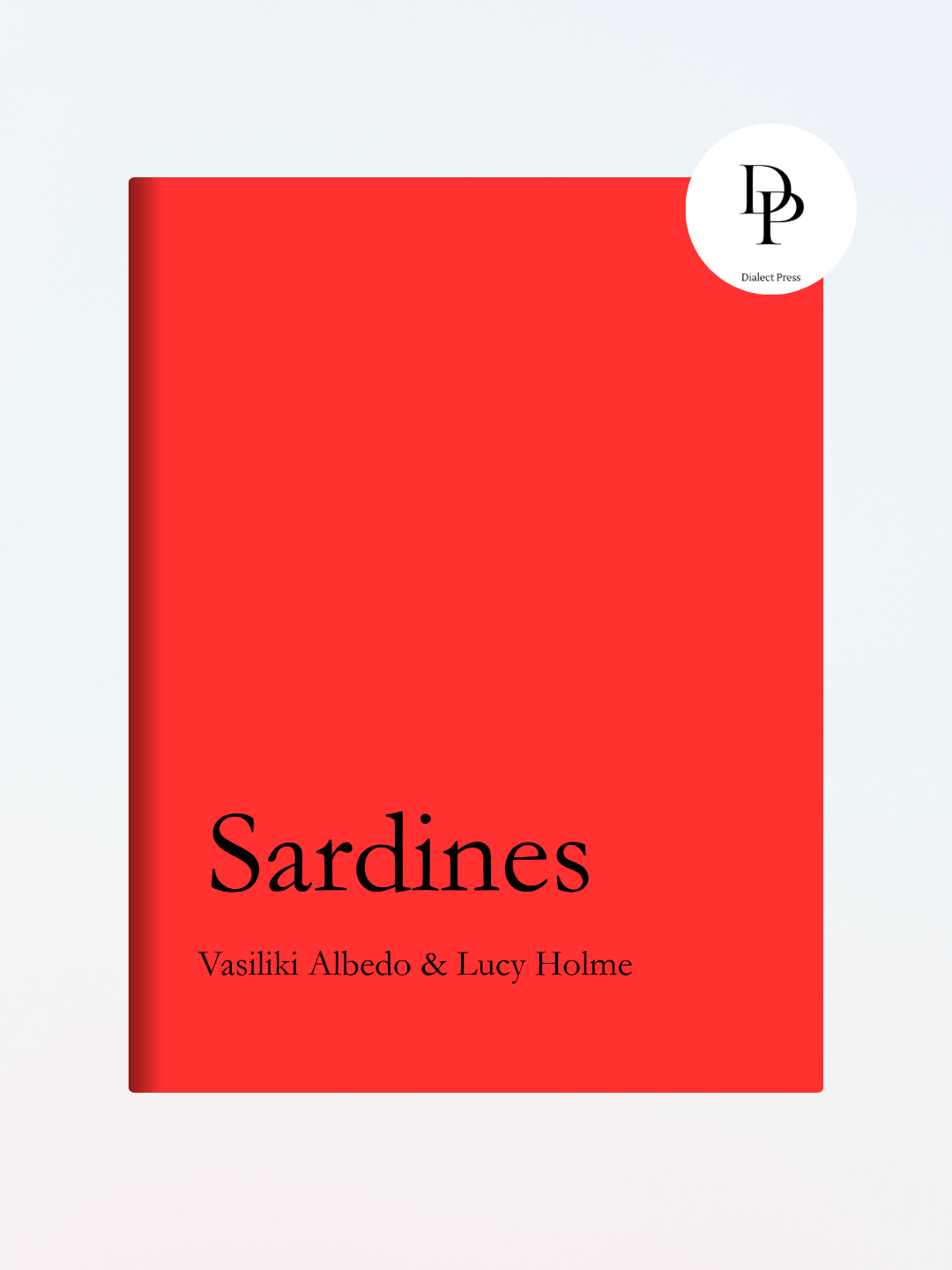
We would love you to join us for the online launch of Sardines - tickets are free but you will need to book so that we can send you the Zoom link. Click this link to book. Vas and Lucy will be launching their pamphlet alongside Ella Duffy and Adam Horovitz’s new book, Rock, Paper, Scissors.
Sardines launches on 2nd February 2026 and will be published in a limited edition. We expect the pamphlets to fly out of the door - preorders are open now! See our bookshop for details.
More about our authors…
Vasiliki Albedo
Vasiliki Albedo is the author of Fire in the Oubliette, joint winner in Live Canon’s pamphlet competition, and Arcadia, winner of Poetry International’s tiny chapbook competition. Her work has appeared in Poetry London, The Poetry Review, Oxford Poetry, The London Magazine, Poetry Ireland Review, banshee and elsewhere. She was shortlisted for a Forward Prize for Best Single Poem (Written) 2024, and has won the Hammond House Literary Prize and The Poetry Society’s Stanza competition.
Lucy Holme
Lucy Holme is a PhD student at University College Cork. Her work features in PN Review, Poetry London, Poetry Ireland Review, and The Stinging Fly amongst others. She won the Cúirt New Writing Prize for Poetry 2024, the Southword’s Editor’s Prize in 2025 and has been a finalist for The Brotherton Prize, The Mairtín Crawford Award and The Fool for Poetry Chapbook Competition (2024 and 2025). Her debut chapbook, Temporary Stasis (Broken Sleep Books 2022) was shortlisted for The Patrick Kavanagh Award. A collection of nonfiction essays, Blue Diagonals, was published in 2024.