

For the DIRT competition 2026, please click here.
Poets Alice Willitts and JLM Morton have teamed up to release DIRT: plantable ecopoetry collaborations that literally go back into the earth.
Why is planting poems a good idea? Following in the footsteps of artists who make work that vanishes back into the place it came from, we want to send our exceptional poems back into the earth we’re writing about.
We’re modelling carbon-positive printing by using carbon-balanced methods and capturing more carbon than is used to distribute our pamphlets by sending seeds to be grown from each planted poem. Ephemeral and brilliant, this plantable poetry idea chimes with other projects like Future Library where the books are written now but will only be printed once the trees needed for the paper have grown in a hundred years time.
Carbon-positive publishing is possible! Poetry is an ideal corner of publishing to lead the innovative changes we want to see and we’d love you to come with us. Welcome to DIRT where we’re trialing publishing practices for a thriving, life-enhancing and modern way of sharing our work with readers.
Roots
We started out with the DIRT Kickstarter which was about raising development funds to pay for time to write the first collaboration so we could accurately estimate the payment to poets for future collaborations; to research carbon-positive publishing (tricky!); and to test how our plantable poetry idea would work in practice. With our early adopters, we took DIRT from an idea to a real place for renewal that nurtures collaborative writing and new publishing methods.
and Seeds
We raised the funds and found our supportive community through the crowdfunding to test the whole concept and publish the first plantable DIRT poetry in carbon-positive publishing mode.
and Shoots
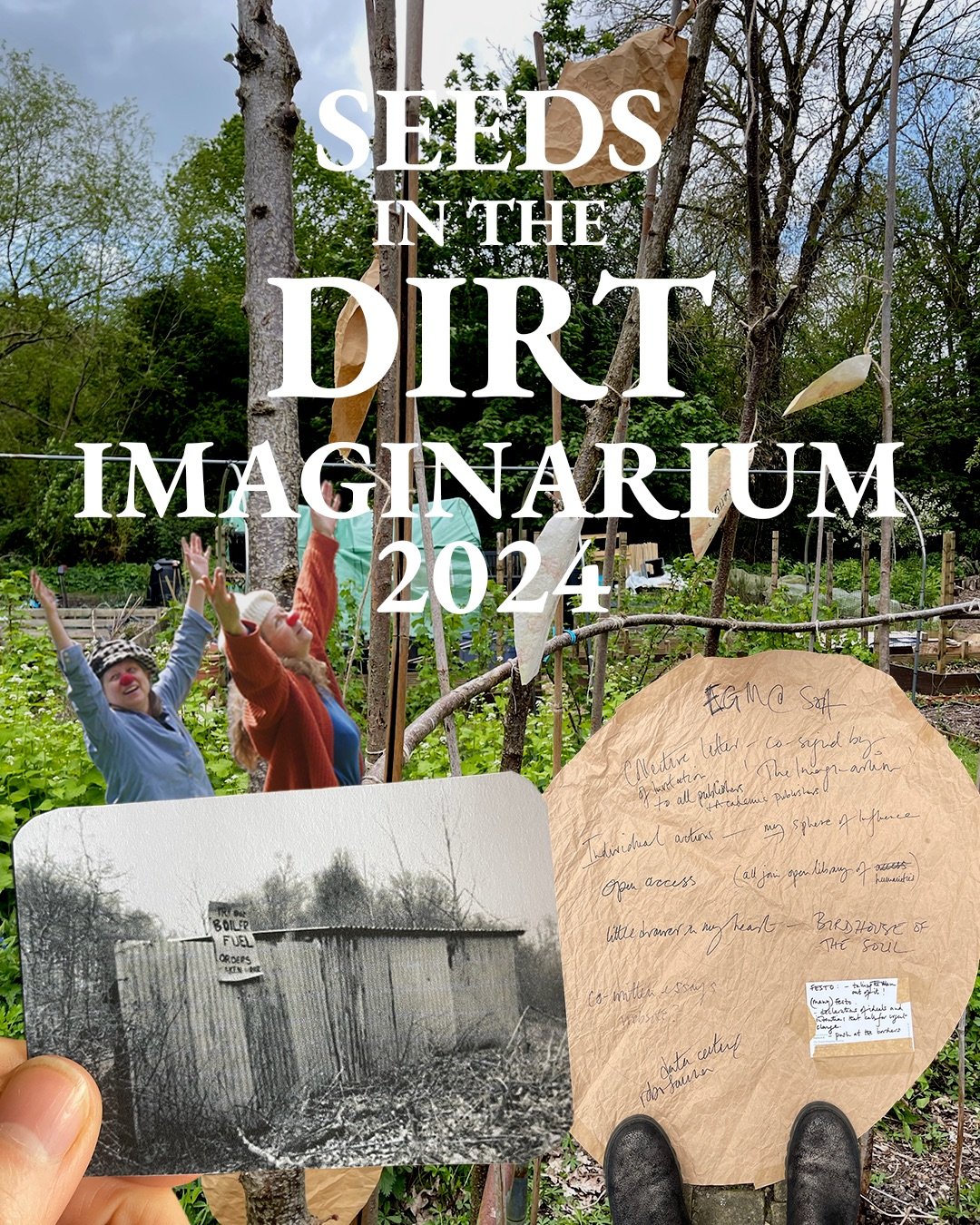
We collaborated with Anglia Ruskin University in Cambridge to host a Seeds in the DIRT Imaginarium asking What if writers’ work was published without literally costing the earth?
and Leaves
Funded by the Sustainable Futures Fund at ARU we commissioned an established poet and emerging poet to collaborate, and hired a student graphic designer to create the front covers for DIRT.
Flowers
With your help we will model a radical, collective poetry that grows with its supporters as real partners. Together, we could help shift poetic collaborations to the centre of publishing and become the future we want to see in poetry.
and Blooms
The Laura Kinsella Foundation has been watching our activities and to our surprise and delight has pledged to fund a series of commissions, massively opening up the scope for more experimentation. What a gift!
and Life
Loops by Clare Pollard and Freya Sacksen is our first commisson. Freya is an emerging writer with special interest in ecopoetics. Clare Pollard has been at the heart of UK poetry since her teens but this is her first time writing in collaboration.
more Seeds
We’ll be commissioning the next collaborations, launching Loops and sowing more seeds both literally and creatively. Did you know that a square meter of meadow absorbs 3kg of carbon in its first year alone?


Seeds in the DIRT
Imaginarium
DIRT’s editor Alice Willitts introduces the Seeds in the DIRT Imaginarium, a new collaborative, forward thinking project funded with £10k from the Sustainable Futures Fund from Anglia Ruskin University’s Global Sustainability Institute.
Once upon a time... I had an idea for gathering together writers who inspire me with their writing and beingness. I spoke of how we would collectively redesign the publishing of our poems and stories to lovingly disrupt and change the way things are done now. We would ask our consciences for ideas on how we can be eco-voices without the conflict of putting out more-more-more ‘stuff’ that damages our home. We’d figure out how to resource writers for eco-conversations with publishers and printers and agents and we’d make a concise manifesto that would be a guiding light along the way of change. We would pledge to deliberately unknow what we know and come with not-knowing-minds to create fabulous, weirder, queerer, boundary-crossing, collaborative thinking that might teach us something precious about how to remove the carbon footprint of our industry. We’d become a writerly ecobody, grounded in its own interests and agitating with compassion from within the publishing industry we find ourselves in. The bloom of our collective flair for action would be so bright and vivacious that even the sun would doff its cap in our general direction!
Powerful dreams have a way of sticking around, and I spoke out loud of my desire and I called it an Imaginarium because it wouldn’t be an incubator or an un-conference, it would be something uniquely of itself and for us. Then one day, someone I’d told about my Imaginarium (JLM Morton!) said, go to a place called Thrive and find a woman called Sarah, who shares her last name with the village south of where you live. When you find this woman, tell her your dream. She will be able to help you. And so it was. And here we are!
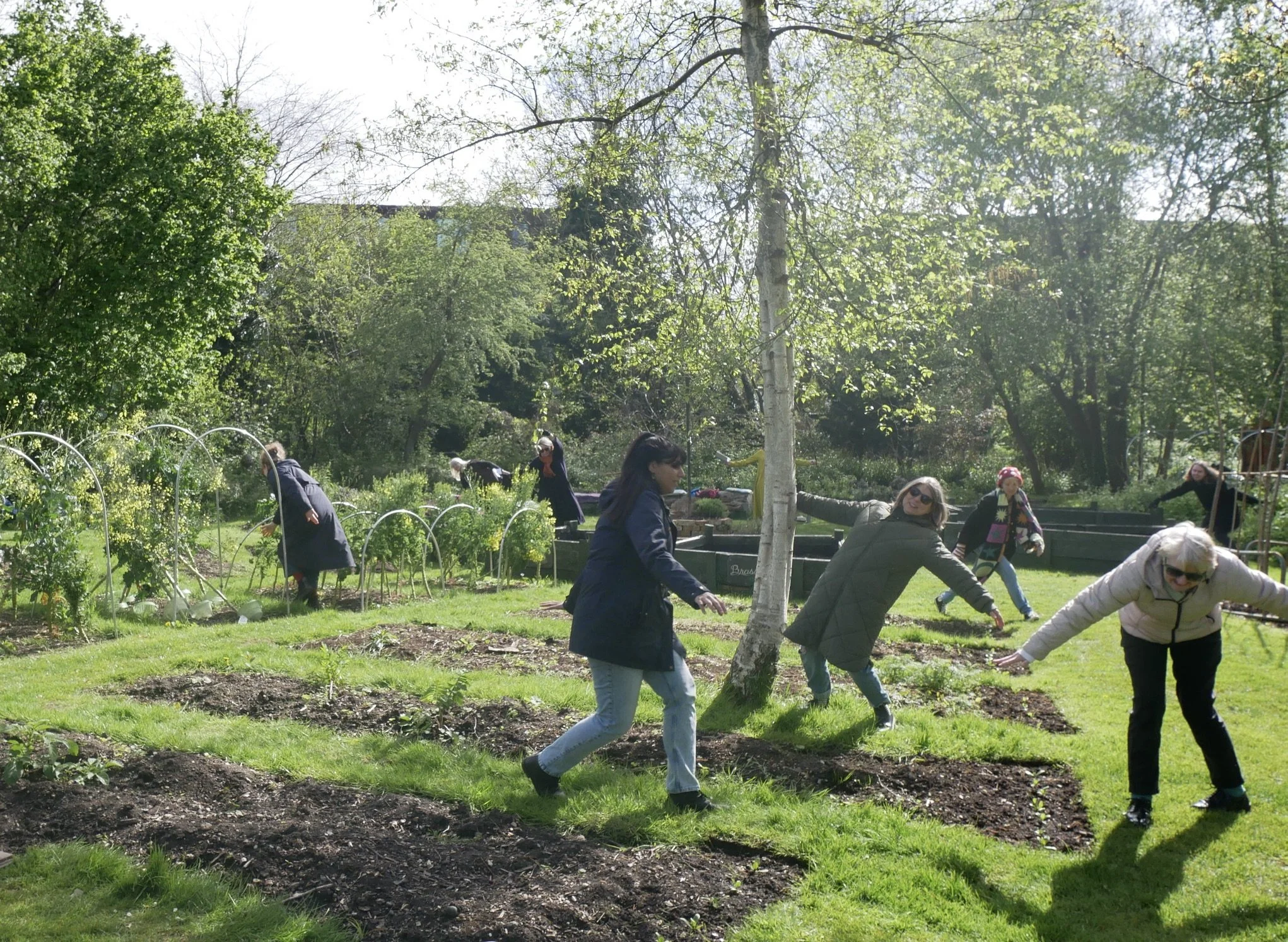
The residential ‘Seeds in the DIRT Imaginarium on ecopoetics and storytelling’ was held at Anglia Ruskin University (ARU), from 19 - 21st April, 2024, co-hosted by Dr Sarah Royston and Alice Willitts, and funded by a generous £10k grant from the Sustainable Futures Fund. Participants included students, writers, academics, a clown, a DJ and a gardener.
Participants: Ali Stockford, Alice Willitts, Alycia Pirmohamed, Annouchka Bayley, Caleb Parkin, Clare Pollard, Clare Whistler, Degna Stone, Freya Sacksen, Holly Trundle, Jac Harmon, JLM Morton, Jon Stone, Kay Syrad, Lisa Farrell, Maria Sanger, Piers Torday, SoA, Rebecca Ostler, Sam Millar, Sam Wigmore, Sarah Gibson-Yates, Sarah Royston, Theo Willitts, Tim Jarvis
#DIRTimaginarium


Participating in the Imaginarium has…




What did the Imaginarium imagine?
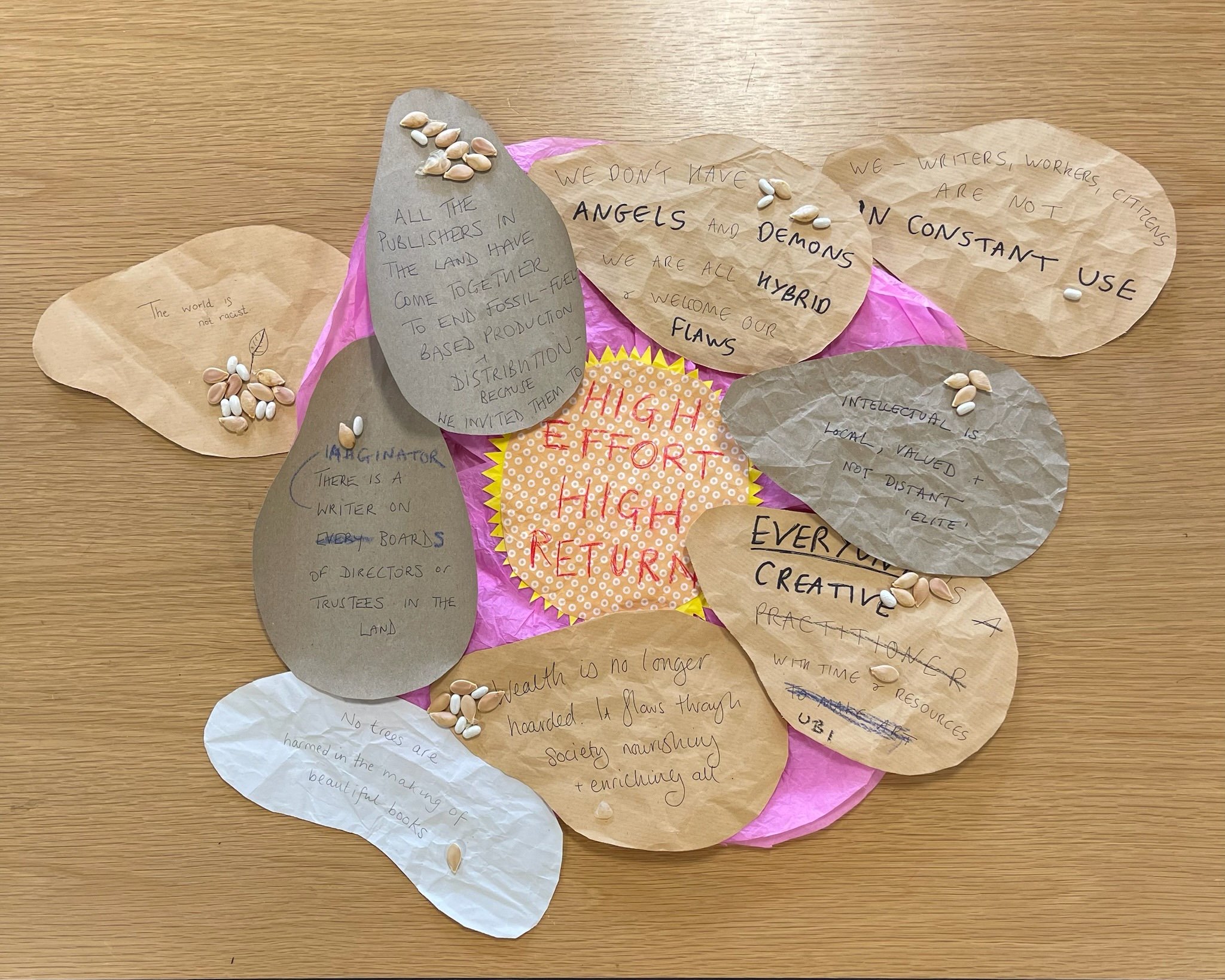
Collectively, we imagined a world that is not racist; where all publishers in the land have come together to end fossil-fuel based production and distribution because we invited them to; a world where we don’t have angels and demons, where we are all hybrid and welcome our flaws; where writers, workers and citizens are not in constant use and where everyone creative has time and resources (Universal Basic Income); a world where wealth is no longer hoarded and flows through society nourishing and enriching all; where writers are on boards of directors or trustees; and we imagined an publishing industry where no trees are harmed in the making of beautiful books.
We asked participants what their own spheres of influence were. The range of who and where we as a small group could reach includes but is not limited to:
Immediate contacts including family, friends, our own publishers and editors.
Literary communities including unions, societies, festival and readings audiences, workshop participants, trustees of literary organisations, panels and prize acceptance speeches.
Wider community including talking to ‘the public’, publishing trade, reviewers and government.
Pedagogic community including fellow students, academics, creative writing workshop participants, university boards and work in schools.
Online platforms including personal and professional social medias and blogs, online magazines. Tag our posts with #PublishCarbonPositive #DirtPoetry #FossilFreePublishing
Direct actions including voting on union motions, taking Seeds in the DIRT ethos to local government, signing petitions, writing letters, adding a request for carbon-positive publishing with all literary submissions, adding information to our email signatures, transforming our own imaginations.
Writing the future we want in prose and poetry, writing transformational stories for our young and adult readers, and comic writing. Writing stories that tell the story of ‘what if…’ and make the future desirable, welcoming and believable.
Other than human including responding to the elements, beauty anywhere, authenticity and natural expression everywhere.
Readers. If readers understood how bad the publishing industry is for the planet, would they drive change by demanding better books? We think so.

What if…
p.s.
“BRAVA all of you! Such a generous, enjoyable gathering! I particularly loved the morning outdoors in the loved garden. Thank you all so much ❤️”
“Change can be small at first, personal.”
“Thanks for such a stunning, jam-packed and varied weekend.”
“It is said that the word ‘clown’ originates from the word CLOD!! Us clowns are earthy creatures!!”
“It was a joy to host the Eco-Prance!”
“We will know the birds by their songs”
“I will be making lassis this week!”
“The imaginarium was brought / not to a close, or even a pause, / It’s more like a caesura… / Here’s to the line continuing.”
“Have you read Braiding Sweetgrass by Robin Wall Kimmerer? The conversation about naming birds made me think of it, as the author knew names of plants through her heritage, then had to learn all the ‘scientific’ names when training as a botanist. Recommended!”
“I just want more, want to do it all again please! I’m taking so many seeds away with me (ha ha literally) and this will change my writing, I’m FEELING new ways of being.”
“This work is intergenerational, thank you for showing us that.”
DIRT Publications
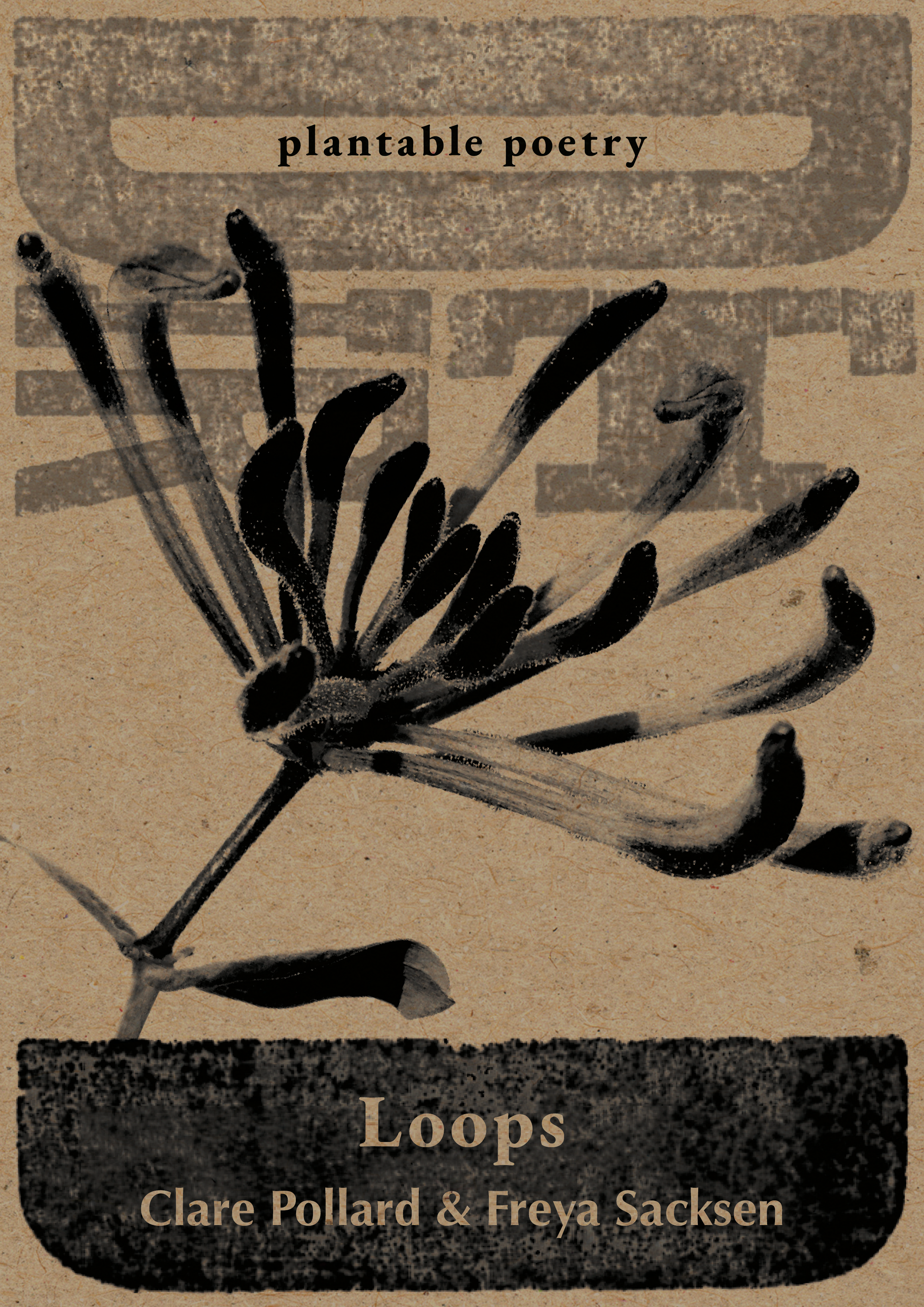
Loops, a collaboration between student Freya Sacksen and poet and novelist Clare Pollard, inspired by climate science on bird migrations.

Hertz bursts out of the restrictions of formal poetic categories. Themes of decaying whilst still alive, and what hurts the living, surface through the poets’ intimate attentions to soil.
This collaboration was funded by the Laura Kinsella Foundation.
DIRT Authors
-
Hannah Copley’s poetry includes Lapwing (Pavilion Poetry) shortlisted for the T. S. Eliot Prize 2024 and Speculum (Broken Sleep Books). She was winner of the 2019 Newcastle Poetry Prize for ‘Juice’ and winner of the 2018 YorkMix/York Literature Festival Poetry Prize for ‘Haworth, 1855’. Hannah is an Editor at Stand magazine and a Senior Lecturer in Creative Writing at the University of Westminster.
-
Alycia Pirmohamed is a Canadian-born poet based in Scotland. In 2023, she won the Nan Shepherd Prize for her nonfiction debut A Beautiful and Vital Place, forthcoming with Canongate. Her poetry includes Another Way to Split Water (Berlinn) and most recently the collaboration this too is a glistening, (Bitter Melon). Alycia is the co-founder of the Scottish BPOC Writers Network and she currently teaches on the Creative Writing MSt at the University of Cambridge.
-
co-author of Loops
Freya Sacksen is a UK-based poet from Aotearoa New Zealand. Their work has been published in digital journals EnbyLife and SWAMP, as well as ARU anthology The Word Is…SMUT. Their poetry embraces storytelling, ecopoetics, liminality and queer identity. Their current favorite example of the Order Lepidoptera is Danaus plexippus.
-
co-author of Loops
Clare Pollard has published five collections of poetry with Bloodaxe, with her sixth - Lives of the Female Poets - forthcoming in 2025. She has also written a non-fiction title, Fierce Bad Rabbits: The Tales Behind Childrens’ Picture Books (Fig Tree), her first children’s novel, The Untameables (The Emma Press), and two adult novels, Delphi and The Modern Fairies (Fig Tree).
-
co-author of Chapel
Editor, DIRT plantable poetrypoet and plantswoman from the Fens www.alicewillittspoet.uk
-
FAQ’s
-
Where the production, storage, distribution and pulping of a book sinks more carbon than it takes.
Re-orienting publishing to place planet at the heart of all aspects of production which would mean calculating the overall value of a publication by how much carbon is re-invested in the ground.
Small and large scale adaptations are already possible.
-
Maybe you shouldn't! Caring might open you to making choices that might be inconvenient, unaffordable or annoying, plus you'd still have to watch other people enjoying what you've 'given up'. On the other hand, if all books were nourishing the environment so that reading a book automatically benefitted our living standards how would you feel then?
-
Change can be small at first, personal. You can stop buying hardback books which are carbon-costly to produce, store and distribute and contain the same information as a paperback. You can tell friends and family about how some writers are trying to change the way their work is published and pester booksellers and publishers to display the carbon cost alongside the price of each book, just like we do for food items. It's a start. You are the consumer and as we're told repeatedly business follows the consumer.
-
Talk directly to your readers, tell them you're ready for a change, ask them to come with you to a future where every book they buy will benefit the environment, where no trees are harmed, where books are made of stone paper and last forever! Make up a world of your choosing (it's literally in our job description) and help your readers believe it could happen. Share your desires with your publisher, editor and agent, find out whether they share your concerns. The SoA's Tree to Me initiative is a good place to start but sometimes this feels too precarious -- with your readers backing you up perhaps it's easier. We start where we can, with our own sphere of influence and grow change from there. Once being carbon-positive becomes popular we'll all be published well. Until then, do what you can and keep imagining what it'll feel like when the values in your writing are matched by the way your books are made and sold.

Subscribe
Subscribe
If you’d like to hear more from DIRT plantable poetry then subscribe to our Substack for irregular newsletters!